Saponifying oils and fats with sodium hydroxide
Intensify phase contact for soap production
During saponification, vegetable or animal oils and fats react with sodium hydroxide to form sodium salts of fatty acids and glycerol. The resulting sodium soaps provide a basis for various washing and cleaning products. This reaction is distinct from other processes used to manufacture synthetic surfactants.
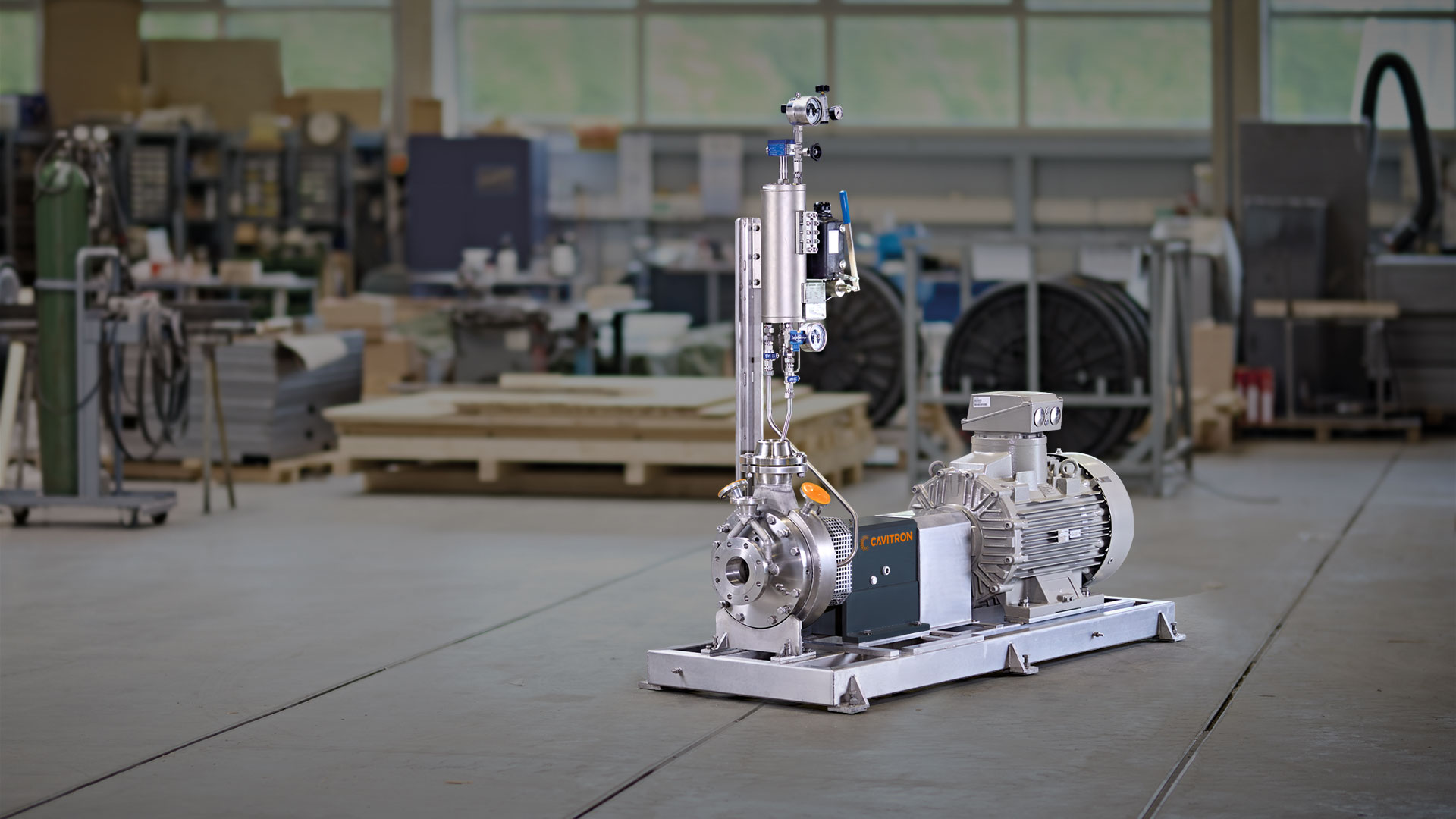
As the fat phase and aqueous lye initially have limited miscibility, effective phase contact is essential. Cavitron rotor-stator systems distribute the phases intensively and increase their contact area, supporting mass transfer and more uniform reaction conditions.

Consider the complete reaction system
- Raw materials and dosing: Fat composition, free fatty acids and saponification value determine lye demand. Variations affect free alkali and residual fat content.
- Phase contact: Inadequate mixing limits mass transfer and can cause local concentration differences.
- Changing viscosity: Flow behaviour, pumpability and mixing requirements change as the reaction progresses.
- Temperature and residence time: Reaction heat and mechanical energy input must be considered. Good mixing alone does not guarantee complete conversion.
Rotor-stator technology as an intensive mixing stage
The fat phase and sodium hydroxide solution are metered together and brought into intensive contact in the rotor-stator zone. Distributing the phases shortens mass transfer distances and establishes more uniform starting conditions for saponification.
The machine is combined with raw material dosing, temperature management and the required downstream reaction section or vessel. Whether continuous processing or recirculation is appropriate depends on reaction kinetics, viscosity development and throughput.
The residence time required is determined by the target conversion. A pass through the mixing zone is not equivalent to complete saponification. Materials and seals must be compatible with the lye, fat and soap under the specified operating conditions.
Benefits at a glance
1
Intensive contact between fat and lye
2
Uniform reaction mixture
3
Reproducible process conditions
4
Integration into continuous lines
5
Design for conversion and product quality
Benefits for your production
Effective phase contact: Intensive distribution of fat and lye improves the conditions for mass transfer at the phase interface.
Uniform reaction mixture: Defined feeding and mixing reduce local variations in composition.
Reproducible operation: Dosing ratio, temperature, throughput and residence time establish a measurable basis for consistent product quality.
Line integration: The inline mixing stage can be combined with dosing, heat transfer and downstream reaction time. Its benefits are assessed within the complete process.
Design for the final product: Free alkali, residual fat, water content and viscosity are considered as specific quality targets.
Design based on reaction and product data
Project design requires oil and fat composition, saponification value, free fatty acid content, NaOH concentration, water balance and required throughput. Viscosity and temperature throughout the reaction determine pumping, drive and heat transfer requirements.
Conversion, free alkali and unreacted fat must be assessed using suitable analytical methods. These establish the reaction time and process sequence required.
Machine configuration and permissible operating limits are specified for each project. See the Cavitron datasheet for an overview.

engineered.