Controlled dispersion of aluminium powders and pastes
Design dispersion around the material and its function
Aluminium is used as a powder or paste in a range of industrial formulations. Depending on the application, the relevant properties may include pigment performance, electrical characteristics or defined reactivity. Particle shape, surface treatment and carrier medium determine suitable processing conditions.
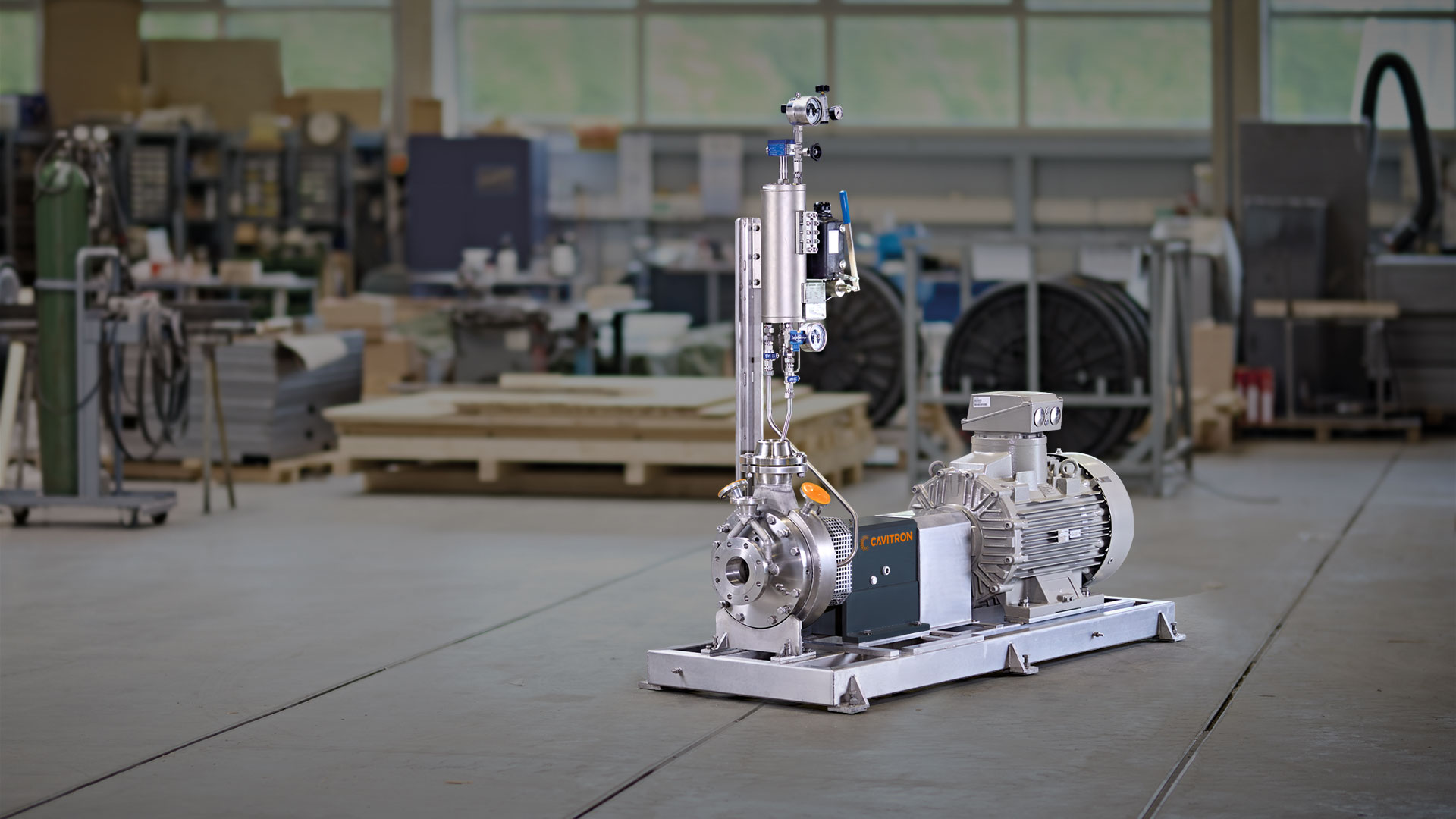
The specific aluminium grade is therefore central to selecting a Cavitron rotor-stator system. The objective is uniform wetting and distribution at a level of mechanical treatment compatible with the required material function. Suitability is assessed for the raw material and formulation.

Disperse while preserving function
- Particle morphology: Spherical powders and platelet pigments respond differently to shear. Sensitive aluminium flakes in particular can be deformed or damaged by intensive processing.
- Surface: Coatings and passivation influence wetting, compatibility and reactivity. Preserving them can be essential to product performance.
- Carrier medium: Solvent-based and aqueous systems present different requirements. Aluminium can react in unsuitable aqueous media, releasing hydrogen.
- Concentration and stability: Solids content, viscosity and formulation determine pumpability, sedimentation behaviour and the processing required.
Limit mechanical treatment to what is needed
A rotor-stator system can break down wettable agglomerates and distribute aluminium uniformly in a liquid stream. Processing must be limited to the level required: tool configuration, speed, throughput and temperature must suit the particle shape and surface treatment.
Gentler mixing technology may be more appropriate for shear-sensitive effect pigments. Equipment selection is therefore based on the resulting product function rather than maximum dispersion intensity. Indiscriminate milling of aluminium flakes is not an appropriate process objective.
Dosing, closed product handling, material compatibility and the required protection concept are considered together for the specific application. A closed machine alone does not ensure a safe process. Raw material supplier instructions must be incorporated into the design.
Benefits at a glance
1
Design for the aluminium grade
2
Controlled wetting and distribution
3
Assessment of particle integrity
4
Defined process conditions
5
Integration into a coordinated plant concept
Benefits for your production
Material-specific selection: Machine configuration is matched to the aluminium grade and carrier medium, avoiding the use of unsuitable standard parameters for sensitive products.
Controlled distribution: Wetting and processing are coordinated to achieve uniform dispersion.
Assess the required function: Particle integrity and application-specific properties are compared before and after processing.
Reproducible conditions: Defined dosing, temperature and mechanical treatment establish a sound basis for process operation.
Coordinated integration: Feeding, pumping, cooling and cleaning are planned together with material-specific requirements.
Assess suitability for your aluminium grade
Assessment requires the exact raw material designation, powder or paste form, particle size distribution and morphology, surface treatment, carrier medium, solids content and throughput. The safety data sheet and supplier processing recommendations form part of the design basis.
Quality testing depends on the application: for example, dispersion quality and sedimentation, optical properties or electrical performance. Changes in particle shape and surface must also be considered.
These findings determine the appropriate machine configuration and operating conditions. General information on the range is available in the Cavitron datasheet.

engineered.