Background and Task
Bentonite is a naturally occurring aluminum silicate characterized by a pronounced capacity for intercrystalline swelling. Due to its unique mineral structure, bentonite can absorb large quantities of water and form stable colloidal suspensions and gels.
These properties make bentonite an important functional material in numerous industrial applications. In addition to its use in civil engineering and environmental technology, bentonite also plays a significant role in the paper industry.
In paper manufacturing, bentonite suspensions are primarily used to:
- flocculate fines and filler particles
- improve the adhesion of clay and mineral particles to paper fibers
- optimize retention and dewatering performance
- enhance paper quality and process stability
The targeted addition of bentonite suspensions improves:
- sheet formation
- surface quality
- the mechanical properties of the paper
- process control within the paper machine
An optimally prepared bentonite suspension also contributes to:
- reducing dust generation
- minimizing losses of sizing agents and minerals
- improving the water balance of the plant
- significantly increasing dewatering efficiency
The performance of a bentonite suspension depends largely on complete hydration, fine dispersion, freedom from agglomerates, and reproducible rheological properties.

The Challenges
The production of high-quality bentonite suspensions for the paper industry places demanding requirements on mixing and dispersion technology.
When brought into contact with water, bentonite tends to form agglomerates if the particles are not wetted immediately and intensively. At the same time, the viscosity of the suspension increases significantly during the mixing process, making further dispersion more difficult.
When conventional agitators are used, the following problems frequently occur:
- insufficient shear forces for complete deagglomeration
- formation of lumps and agglomerates (“fish eyes”)
- uneven hydration of the bentonite particles
- long swelling and maturation times
- inconsistent suspension quality
- high energy consumption
- significant dust generation during powder feeding
- large space requirements due to oversized mixing and maturation tanks
For paper manufacturers, however, a consistently high-quality and reproducible suspension is essential.
Even minor fluctuations in bentonite quality can negatively affect:
- retention
- dewatering performance
- paper formation
- filler retention
- surface quality
Modern paper machines operate continuously at high production rates, requiring a particularly reliable and economical method for preparing bentonite suspensions.
The Solution
For many years, Cavitron has supplied machinery and systems for the production of high-quality bentonite suspensions for a wide range of industrial applications, including systems for the pulp and paper industry.
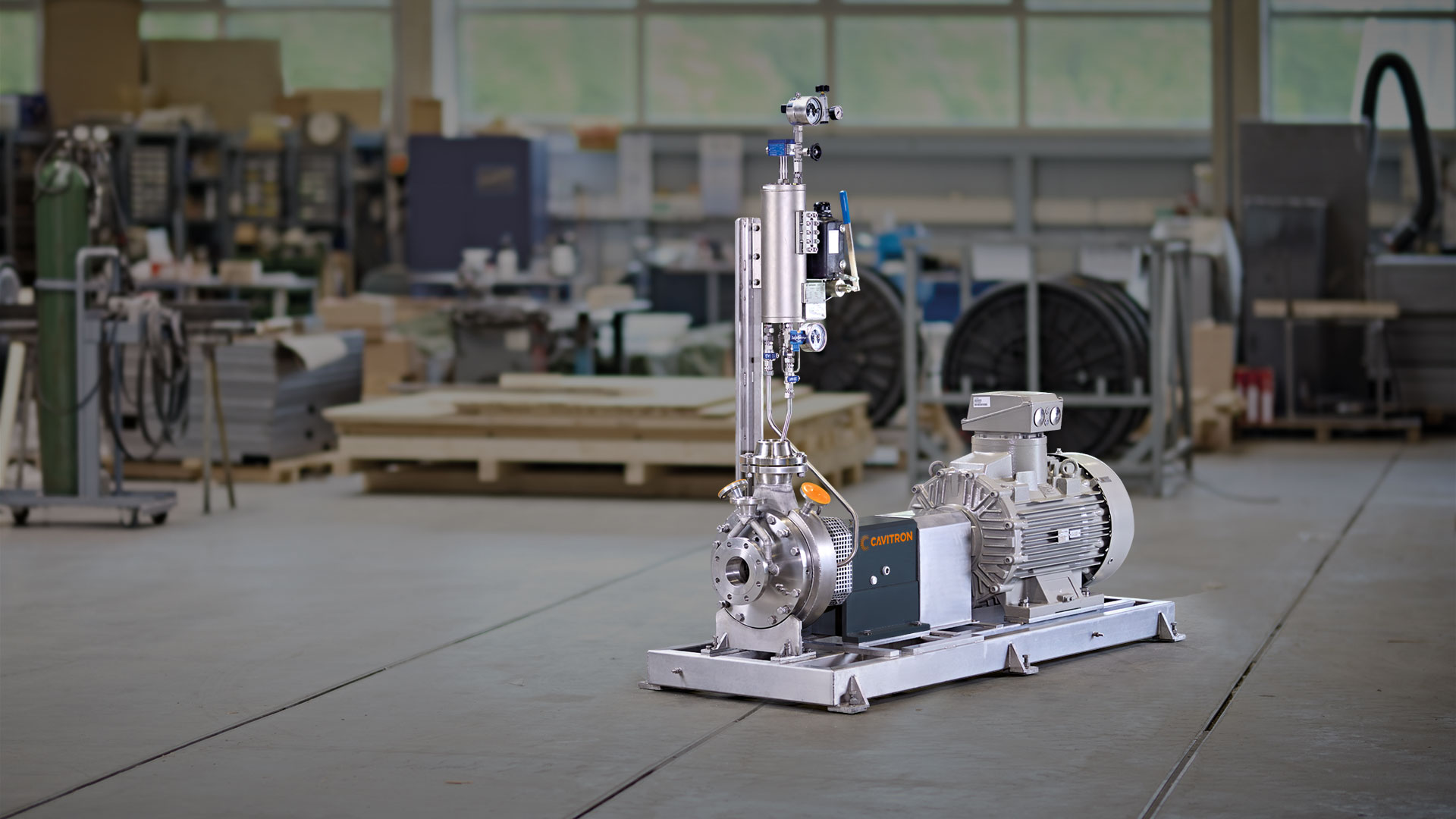
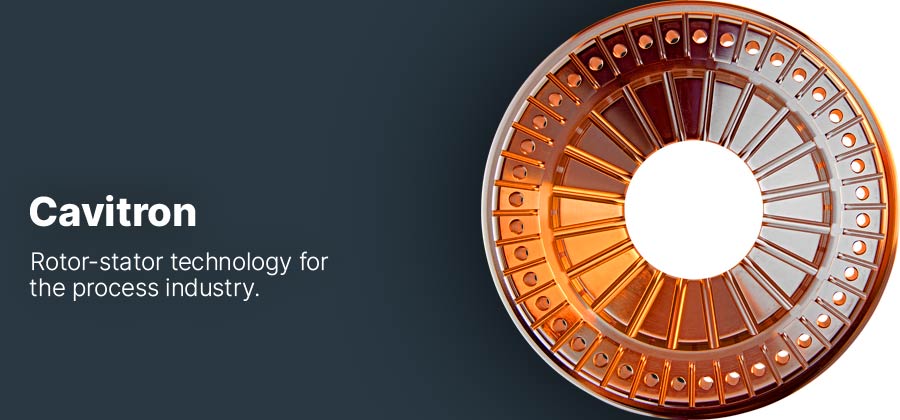
At the heart of these systems is the Cavitron inline disperser featuring a specially developed rotor/stator system.
During the continuous process, the bentonite-water mixture is directed through the machine’s high-shear processing zone. Intense hydraulic and mechanical shear forces break down bentonite agglomerates and distribute the particles uniformly throughout the liquid.
This intensive deagglomeration process:
- maximizes the active surface area of the bentonite particles
- significantly accelerates hydration
- activates gel formation
- produces a stable and homogeneous suspension
The integrated pumping action of the Cavitron machine then transfers the suspension directly into an intermediate or maturation tank, where the final rheological properties are achieved within a short time.
Compared to conventional agitator-based systems, the Cavitron solution enables:
- significantly shorter process times
- lower energy consumption
- reproducible product quality
- reduced dust emissions
- a compact and cost-effective plant design
Various rotor/stator geometries and system configurations allow precise adaptation to:
- the bentonite grade
- solids concentration
- production capacity
- specific customer process requirements
Additional benefits for paper manufacturers include:
- high product quality through intensive deagglomeration and homogeneous particle distribution
- improved paper quality
- optimized retention and dewatering performance
- reproducible process conditions
- shorter process and maturation times
- energy-efficient and economical operation
- low dust generation and improved workplace safety
- robust and versatile operation for continuous industrial use
- reduced maintenance requirements
- tailored solutions for individual production requirements
Available options include:
- various rotor/stator systems
- dosing systems
- hopper solutions
- automation technology
- complete inline dispersion systems
In addition to stand-alone machines, Cavitron supplies complete process systems including vessels, dosing equipment, conveying technology, control systems and maturation units.
Conclusion
The quality of bentonite suspensions has a decisive influence on the efficiency and product quality of modern papermaking processes. Complete hydration and homogeneous dispersion of bentonite particles are essential prerequisites for stable retention, flocculation and dewatering performance.
Thanks to their high-shear rotor/stator technology, Cavitron inline dispersers enable the rapid, reproducible and economical production of high-quality bentonite suspensions for the paper industry.
As a result, process times, energy consumption and maintenance requirements are significantly reduced while process stability and paper quality are improved.
With decades of experience in dispersion and process engineering, Cavitron is a trusted partner for the design of new process plants, the optimization of existing operations and the development of tailored solutions for demanding pulp and paper applications.
Overview of Customer Benefits
1
High product quality
2
High process control and reproducible quality
3
Controlled energy input
4
Space-saving and clean
5
Lower environmental impact
6
Robust and efficient
7
Flexible and versatile
8
Tailor-made solutions
9
Accessories and plant engineering
Customer Benefits in Detail
- High product quality
The rotor–stator system, designed specifically for ASA applications, ensures rapid emulsification and homogeneous distribution, resulting in a highly stable emulsion. - High process control and reproducible quality
The machine operates with precision and reliability, delivering consistent results. Continuous operation in a closed system further accelerates the process. - Controlled energy input
Rotational speed—and therefore shear intensity—can be precisely adjusted at the emulsifier. - Space-saving and clean
Compared to traditional batch production, Cavitron’s continuous system requires up to 90% less space. No sticky tanks or internal components accumulate residue, as the product is positively conveyed through the machine. This minimizes deposits and reduces cleaning demands. - Lower environmental impact and maximum occupational safety
Encapsulation occurs in a closed system. No dust escapes into the ambient air, improving worker safety and environmental protection. - Robust and efficient
Lower energy demand than comparable systems, simple maintenance and high tolerance to viscosity fluctuations. - Flexible and versatile
The high-performance Cavitron machine enables processing of various product grades and formulations. - Tailor-made solutions
Cavitron machines can be custom-configured for specific applications and customer requirements—different rotor–stator systems, shaft seals, motors and drives, heating/cooling jackets, injection ports or multistream inlets. - Accessories and plant engineering
In addition to stand-alone machines, Cavitron supplies complementary system components (hoppers, tanks, dispersers, etc.) as well as complete process plants.
For paper and board manufacturers, ASA emulsions produced with Cavitron systems exhibit high stability, excellent hydrophobization efficiency and low deposition tendencies under process conditions. Users benefit not only from improved product quality but also from significant increases in process efficiency and energy savings.
General Technical Specifications
Static seals:
Viton, Teflon, Kalrez, other elastomers.
Operating pressure:
Application-dependent, up to 100 bar; standard: up to 10 bar.
Operating temperature:
Application-dependent up to 250 °C; standard: 150 °C.
Performance and energy consumption:
Type overview available for download.
Drives and power transmission:
Three-phase motors, high-frequency motors, mechanical gear units, variable-speed drives, stepless electronically controlled and monitored systems.
V-belt and Poly-V belt drives.
Intensity levels:
Application-specific, ranging from coarse mixing to dispersion in the angstrom range.
Bearings:
Tapered roller bearings, angular contact ball bearings (double).

engineered.