Background and Objectives
Rubber-modified polymers are engineering plastics in which elastomeric components are deliberately incorporated into a thermoplastic polymer matrix to significantly enhance the mechanical properties of the final product.
The following properties are significantly improved:
- impact strength
- elasticity
- stress crack resistance
- low-temperature performance
- general fracture toughness
Among the most important rubber-modified polymers are:
- high-impact polystyrene (HIPS)
- acrylonitrile-butadiene-styrene (ABS)
- styrene-butadiene copolymers (SB or SBR)
These materials are used worldwide in:
- electronics housings
- household appliances
- packaging
- automotive components
- toys
- technical molded parts
To manufacture these products, synthetic rubber, typically polybutadiene or styrene-butadiene rubber (SBR), must first be completely dissolved and homogeneously dispersed within styrene monomer or styrene-acrylonitrile systems.
This process yields a rubber slurry that serves as the starting material for subsequent polymerization.
The quality of the resulting plastic is critically influenced by:
- complete solubilization of the synthetic rubber
- fineness of particle size reduction
- homogeneity of the dispersion
- constant process conditions
Insufficient dissolution or uneven distribution of the synthetic rubber can lead to:
- gel particles
- inhomogeneities
- surface defects
- filtration problems
- reduced mechanical properties
Traditionally, synthetic rubber was dissolved discontinuously in large stirred vessels. In this batch process, rubber blocks were introduced directly into the styrene monomer and stirred intensively for many hours until a sufficiently homogeneous solution was formed.
However, as demands for product quality, process efficiency, workplace safety and environmental compatibility increase, this method is increasingly reaching its limits.
The production of high-quality rubber-modified polymers therefore requires a process solution that efficiently combines size reduction, dispersion and dissolution within a controlled continuous process.

The Challenges of Processing Synthetic Rubber
Polybutadiene or SBR rubber is typically delivered in large bales weighing approximately 35 kg each. Due to the high elasticity and cohesion of the material, direct and rapid dissolution in the monomer is difficult.
Processing synthetic rubber therefore places high demands on mixing and comminution technology.
Shearing Action
Conventional agitators often do not generate the shear intensity required to sufficiently comminute and homogeneously disperse the synthetic rubber.
As a result, the following may remain in the product:
- undissolved particles
- gel lumps
- coarse residues
Process and Maturation Times
Since the rubber particles are penetrated by the monomer only slowly, long mixing and swelling times are required.
Deposits and Clogging
Incompletely dissolved rubber residues frequently lead to:
- clogging of basket strainers
- deposits in pipelines
- increased cleaning effort
Energy Consumption
Long mixing times and large agitator volumes result in high specific energy consumption.
Safety and Environmental Requirements
The processing of highly volatile styrene monomers in open or semi-open systems can lead to:
- increased emissions
- odor nuisance
- heightened requirements for explosion protection
Modern production processes therefore require:
- closed systems
- controlled process conditions
- ATEX-compliant plant technology
Product Quality
Discontinuous batch processes make reproducible process control more difficult and frequently lead to fluctuations in:
- viscosity
- rubber distribution
- solids content
The Solution: Continuous Rubber Dissolution Systems from Hosokawa Micron and Cavitron
Since 1988, Hosokawa Micron and Cavitron have jointly supplied high-performance dissolution systems for the continuous processing of synthetic rubber in the production of rubber-modified polymers.
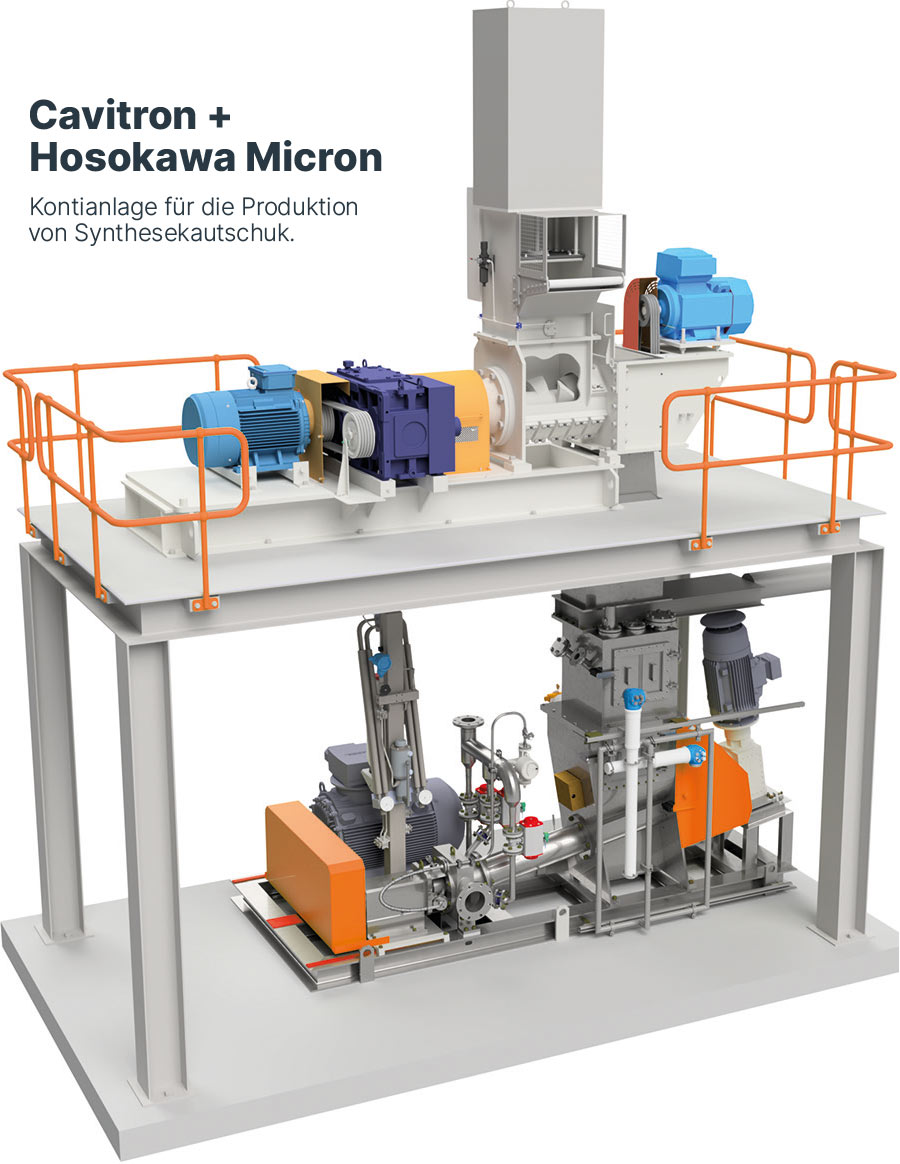
The system combines the following steps in a closed continuous process:
- primary size reduction
- fine size reduction
- dispersion
- homogenization
- solubilization
Hosokawa Micron Rubber Chopper
The first process step is carried out using the proven PB15 Rubber Chopper from Hosokawa Micron.
This machine was developed specifically for the pre-size reduction of synthetic rubber bales and is characterized by:
- robust construction
- high operational reliability
- energy-efficient operation
- long service life
The Rubber Chopper continuously reduces the incoming rubber blocks into granules of a defined size. This significantly increases the specific surface area and creates optimal conditions for the subsequent dissolution process.
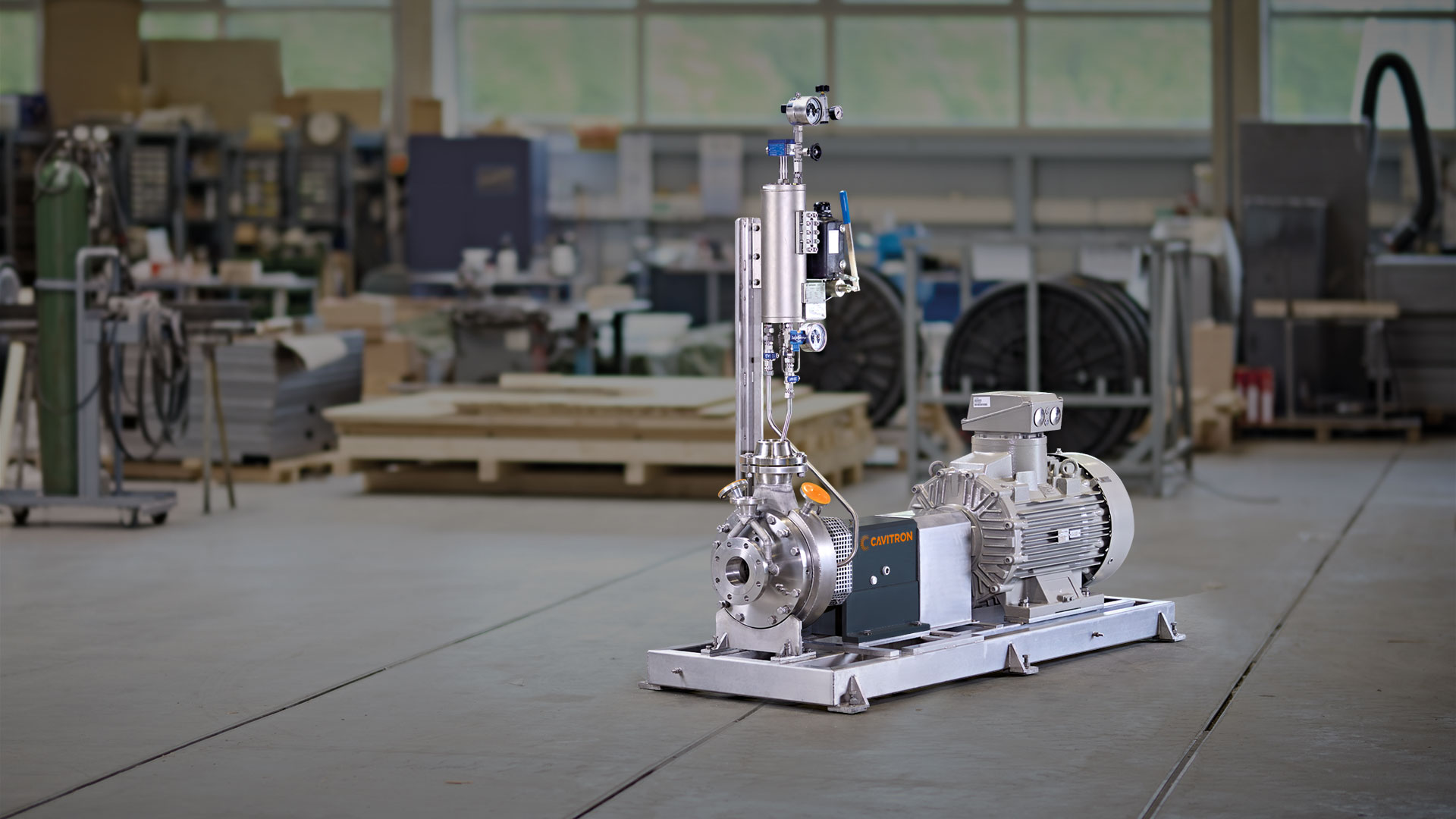
Cavitron Rubber Dissolution Unit
The pre-size-reduced rubber granules are then fed continuously into the Cavitron rubber dissolution unit.
Via a screw conveyor, the granules enter the Cavitron Dissolver while the styrene monomer is injected simultaneously.
The specially developed rotor/stator system generates:
- intensive shear forces
- high turbulence
- optimized flow conditions
As a result, the rubber particles are finely reduced, intensively wetted and uniformly dispersed within the monomer.
The high shear energy significantly increases the contact surface area between the synthetic rubber and the styrene. This allows the monomer to diffuse into the polymer structure more rapidly. The rubber swells and begins to solubilize while still inside the dissolver.
At the same time, continuous forced conveyance prevents:
- agglomerate formation
- sedimentation
- localized concentration gradients
A degree of dissolution of up to 90% is achieved immediately upon exiting the Cavitron Dissolver.
The resulting rubber slurry is then conveyed continuously into a maturation tank, where complete solubilization takes place under controlled conditions.
The result is a highly homogeneous and reproducible rubber solution that serves as an ideal starting point for subsequent polymerization.
Customer Benefits
- fully automatic continuous processing
- combination of size reduction, dispersion, homogenization and dissolution
- high dissolution efficiency
- minimized residues and undissolved particles
- high product quality and consistent final product quality
- processing of more than four tons of synthetic rubber per hour
- production of highly concentrated rubber solutions
- reduced mixing times, energy consumption, solvent losses and operating costs
- reduced maintenance requirements
- reduced basket strainer clogging, deposits and cleaning intervals
- high process safety and ATEX compliance
- compact and space-saving design
- flexible processing of different rubber types, formulations, concentrations and polymer formulations
Conclusion
The continuous processing of synthetic rubber such as polybutadiene or SBR is a critical process step in the manufacture of modern rubber-modified polymers.
The dissolution system developed by Hosokawa Micron and Cavitron combines size reduction, dispersion and solubilization within a highly efficient continuous process, creating optimal conditions for the production of high-quality ABS, HIPS and SB polymers.
Thanks to the intense shearing and dispersing action of the Cavitron Dissolver, highly homogeneous rubber solutions are generated, enabling reproducible polymerization and consistently high product quality.
Compared to traditional batch processes, users benefit from:
- significantly reduced process times
- lower energy consumption
- reduced emissions
- improved workplace safety
- lower maintenance and operating costs
The system has proven its worth in numerous production facilities worldwide and has been a vital component of modern polymer and plastics manufacturing for decades.
Overview Customer Benefits
1
Fully automatic operation with high dissolution efficiency
2
Significantly reduced throughput times
3
Suitable for processing large production volumes
4
Processes more than four tons of synthetic rubber per hour
5
Flexible and versatile for a wide range of formulations
6
Reduced environmental impact through closed-system operation
7
Compact and space-saving design
8
Reduced maintenance requirements and cleaning effort
9
High process control for reproducible product quality
10
Efficient production of high-quality thermoplastics
Benefits in Detail
- Fully automatic operation and high dissolution efficiency: The fully automatic, continuously operating system combines size reduction, homogenization and dissolution in a single system.
- Reduced throughput times: Process times are significantly shortened, while energy demand and operating costs are reduced.
- Processing of large volumes and high rubber concentrations: The system processes more than four tons of rubber per hour and produces highly concentrated rubber solutions.
- Flexible and versatile: The high-performance Cavitron machine enables the processing of different product grades and formulations.
- Lower environmental impact and maximum occupational safety: Since the material is processed in a closed system, particles and vapors are not released. The system naturally complies with European ATEX directives for use in potentially explosive atmospheres.
- Compact, space-saving design: The compact design significantly reduces the required floor space, which is especially beneficial for production facilities with limited space.
- Reduced maintenance requirements: Intensive rubber size reduction results in fewer residues and eliminates the need for regular cleaning of basket strainers.
- High process control for reproducible quality: The system operates precisely and reliably, delivering consistently high product quality. Processes and results remain reproducible at all times.
- Proven continuous rubber dissolution technology: Dissolution systems for the continuous processing of rubber from Hosokawa Micron and Cavitron enable efficient, high-quality thermoplastics production while helping reduce production costs and improve sustainability.
- Proven worldwide since 1988: The system has proven itself with numerous customers worldwide and has become an essential component in the production of ABS, HIPS, SBR and SB.
Technical Specifications
Static seals: Viton, Teflon, Kalrez and other elastomers.
Operating pressure: Application-dependent, up to 100 bar; standard: up to 10 bar.
Operating temperature: Application-dependent, up to 250 °C; standard: 150 °C.
Performance and energy input: Type overview Download.
Drives and power transmission: Three-phase motors, high-frequency motors, mechanical gearboxes, variable-speed drives, continuously variable electronically controlled drives, V-belts and poly-V belts.
Intensity levels: Process-specific, from coarse mixing to dispersion in the ångström range.
Bearings: Tapered roller bearings, double angular contact ball bearings.

engineered.