Dissolving and emulsifying EPDM
Ethylene-propylene-diene rubber (EPDM) is a versatile elastomer valued for its weathering and ozone resistance and its elasticity. Typical products include seals, hoses and profiles for automotive and construction applications.
When preparing EPDM-containing formulations, the rubber must be incorporated uniformly into a suitable liquid medium, such as a compatible solvent, plasticiser or polymer phase. Dissolution and preparation of an emulsion are distinct operations: the achievable state depends on the EPDM grade, medium and formulation. Uniform distribution is essential for the required material and processing properties.

The process challenge
EPDM’s elasticity and the viscosity that develops during incorporation place demanding requirements on mixing equipment.
- High viscosity: conventional agitators can struggle with tough, rubber-like feed and concentrated formulations.
- Uneven particle size: insufficient size reduction leaves coarse particles or agglomerates, making uniform distribution difficult.
- Long processing times: wetting, swelling and dissolution may require successive stages and sufficient residence time.
- Process instability: temperature fluctuations and inadequate mixing can change viscosity and impair product quality.
The Cavitron approach
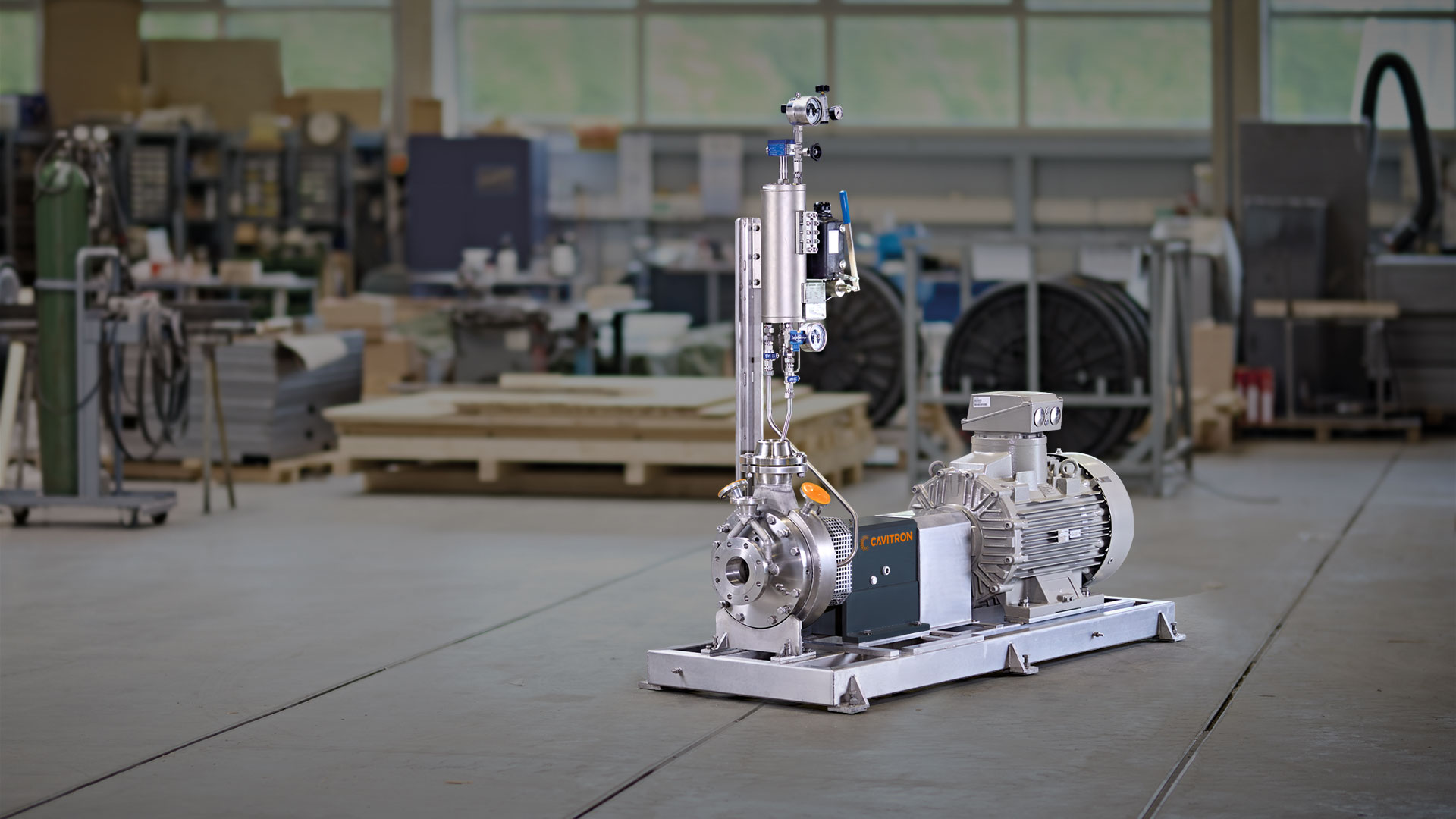
Cavitron rotor-stator systems provide size reduction and intensive mixing for EPDM incorporation. The defined rotor-stator gap generates shear and turbulence as material passes through the machine, increasing the contact area between the rubber and the carrier liquid.
- Intensive shear: supports size reduction and the breakdown of agglomerates.
- Controlled inline processing: coordinates feed, flow and temperature to support consistent product properties.
- Application-specific configuration: adapts the rotor-stator system to viscosity, medium and additives.
Complete dissolution is not established by passage through the machine alone. The medium’s solvency, rubber grade, concentration, temperature and available swelling or dissolution time must also be considered.
Customer benefits at a glance
1
Choice of rotor-stator systems
2
Integration of process stages
3
Efficient wetting and size reduction
4
Compact inline equipment
5
Controlled material flow
6
Temperature and pressure control
7
Targeted energy input
8
Closed processing
9
Application-specific solids loading
Benefits in detail
- Choice of rotor-stator systems: equipment can be selected for different viscosity ranges, media and formulations.
- Process integration: size reduction, dispersion and homogenisation can be combined, reducing transfers where the process permits.
- Shorter preparation: effective wetting and size reduction can shorten mixing stages. Required dissolution time remains formulation-dependent.
- Compact equipment: inline integration can reduce the space occupied by the mixing stage. Total plant space depends on any necessary feed, holding and maturation equipment.
- Controlled material flow: conveying through the processing zone supports consistent treatment and can limit deposits; cleaning requirements remain product-specific.
- Temperature and pressure control: defined process zones support monitoring and control to limit thermal damage and unwanted reactions.
- Targeted energy input: shear is applied in the active processing zone. Energy requirements must be assessed for the complete process.
- Closed processing: containment can reduce releases during mixing. Sealing, ventilation and explosion-protection requirements must be established for the actual medium.
- Concentrated formulations: feasibility depends on viscosity, feedability, heat removal and the required product properties.
Specify the EPDM grade, carrier liquid, concentration, throughput and final product requirements so that Cavitron can assess the process and appropriate machine configuration.
Technical configuration
Operating limits and materials must be selected for the actual formulation and machine configuration. The general Cavitron range below is not a blanket operating specification for every application.
Static seals: Viton, Teflon, Kalrez and other elastomers, subject to chemical compatibility.
Operating pressure: application-dependent configurations up to 100 bar; standard range up to 10 bar.
Operating temperature: application-dependent configurations up to 250 °C; standard range up to 150 °C. The permissible product temperature may be lower.
Performance and energy input: consult the Cavitron type overview (PDF in German).
Drives and transmission: three-phase and high-frequency motors, mechanical gear units, variable-speed drives, V-belt and poly-V belt drives according to the design.
Process intensity: rotor-stator geometry and operating conditions are selected for the mixing or dispersion duty. Achievable product characteristics require application-specific assessment.
Bearings: tapered roller bearings or double angular-contact ball bearings according to the machine configuration.

engineered.