Dispersing carbon black in solvents
Carbon black dispersions for defined product properties
Carbon black gives printing inks, paints and coatings their black colour and can provide electrical conductivity in suitable formulations. Performance depends on the carbon black grade, wetting, dispersion quality and stabilisation in the liquid phase.
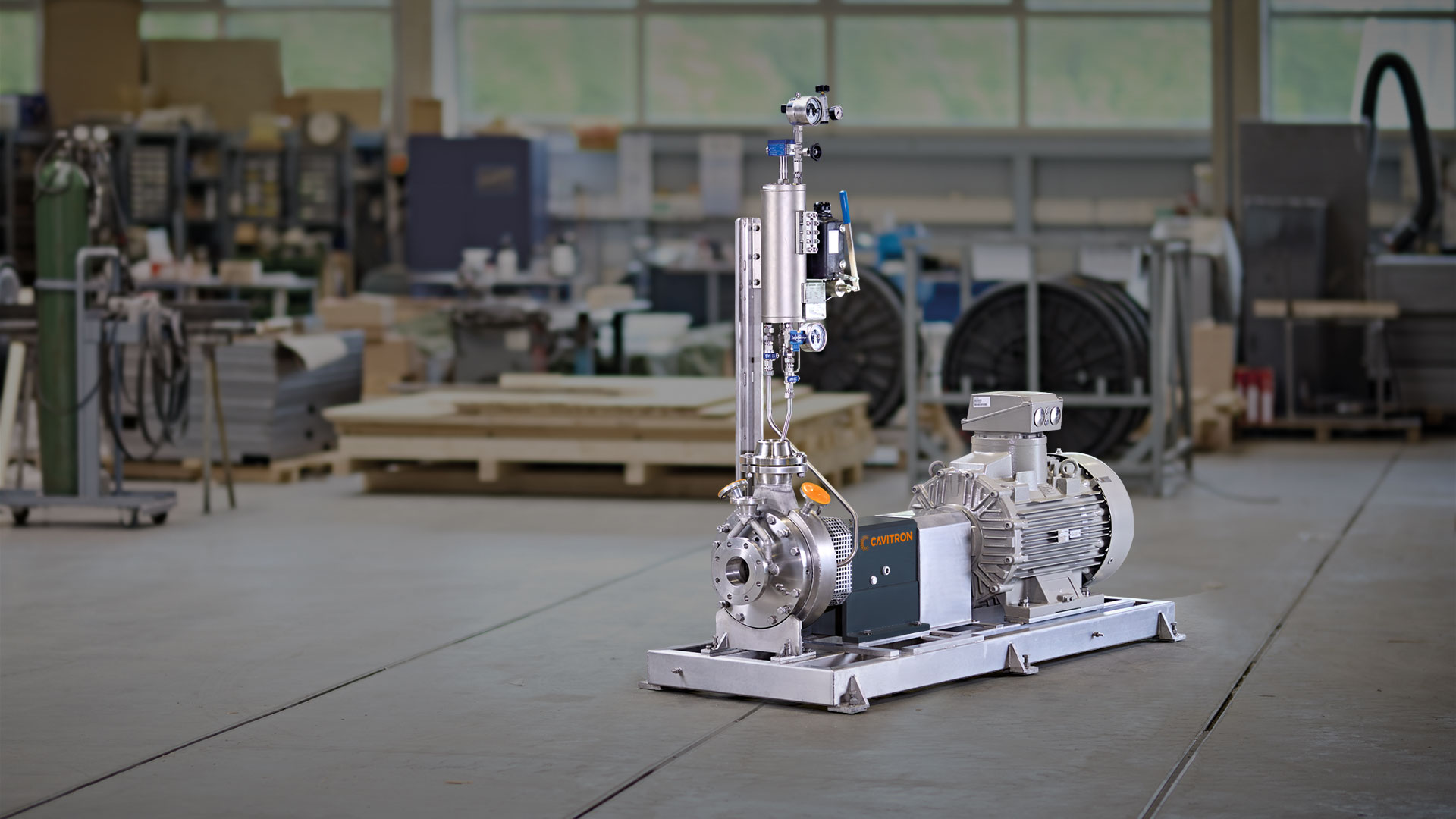
Cavitron rotor-stator systems wet and deagglomerate carbon black in the product stream. They can serve as a pre-dispersion stage before fine milling or, where the quality requirements allow, as the main dispersion stage. The required process sequence depends on the specific formulation.

Break down agglomerates and preserve function
Carbon black consists of primary particles fused together into aggregates. These form larger agglomerates. Dispersion mainly breaks down agglomerates and wets the exposed surfaces. Complete separation of aggregates into individual primary particles is not an appropriate general performance criterion.
- Wetting and stabilisation: The liquid phase, binder and dispersing additives must suit the carbon black to maintain its distribution after processing.
- Viscosity: Surface area, structure and concentration strongly influence flow behaviour and pumpability.
- Functional target: Colour depth, gloss and tinting strength require different tests from those used to assess a conductive network.
- Temperature and material handling: Energy input, solvents and dusty raw materials determine the requirements for cooling, dosing and the protection concept.
Targeted rotor-stator dispersion
The wetted carbon black mixture passes through the active processing zone. Shear and turbulent flow break down agglomerates and distribute the carbon black in the liquid phase. Rotor-stator configuration, speed and throughput are matched to viscosity and the required dispersion effect.
The machine can be integrated into a continuous process or a vessel recirculation loop. Raw material feeding, pumping and heat removal form part of plant design. Powder induction is a separate feed-system function that must be specified accordingly.
The need for a bead mill or another fine-milling stage is assessed against the required quality. A single pass does not generally replace fine milling. Closed processing, materials, seals and, where required, explosion protection are specified for the solvent used.
Benefits at a glance
1
Targeted wetting and deagglomeration
2
Defined quality for downstream processing
3
Controlled energy input
4
Closed inline processing
5
Design for function and formulation
Benefits for your production
Combine wetting and deagglomeration: Intensive processing creates a more uniform dispersion as the starting point for subsequent operations.
Provide defined feed quality: Reproducible pre-dispersion can reduce the load on downstream milling. Benefits are assessed using throughput, quality and the specific energy consumption of the entire line.
Apply energy where needed: Matching tool configuration, speed and throughput limits unnecessary processing and supports appropriate temperature management.
Integrate into a closed system: Inline processing supports closed product handling. Emission reduction also requires appropriately designed feeding, sealing and venting.
Design for function: Selection considers pigment performance or conductivity, together with formulation processability and storage behaviour.
Design and quality verification
Required information includes carbon black grade and supplied form, solvent and binder system, additives, solids content, viscosity at process temperature and required throughput. The permissible temperature and existing pumping and cooling equipment are also relevant.
Depending on the application, acceptance criteria can include agglomerate fineness, tinting strength, gloss, electrical properties, viscosity and storage stability. Machine capacity and the process sequence are specified against these targets.
Operating limits depend on the machine configuration and process media. See the Cavitron datasheet for an overview of the range.

engineered.