Dispersing fumed silica in polyester resins
Targeted rheology control
Fumed silica (SiO₂), such as AEROSIL®, is used in unsaturated polyester resins to adjust viscosity, thixotropy and sag resistance. The resin needs to flow sufficiently under processing shear and rebuild structure after application. In coatings, gelcoats and fibre-reinforced components, this behaviour affects levelling, sagging and fibre wet-out.
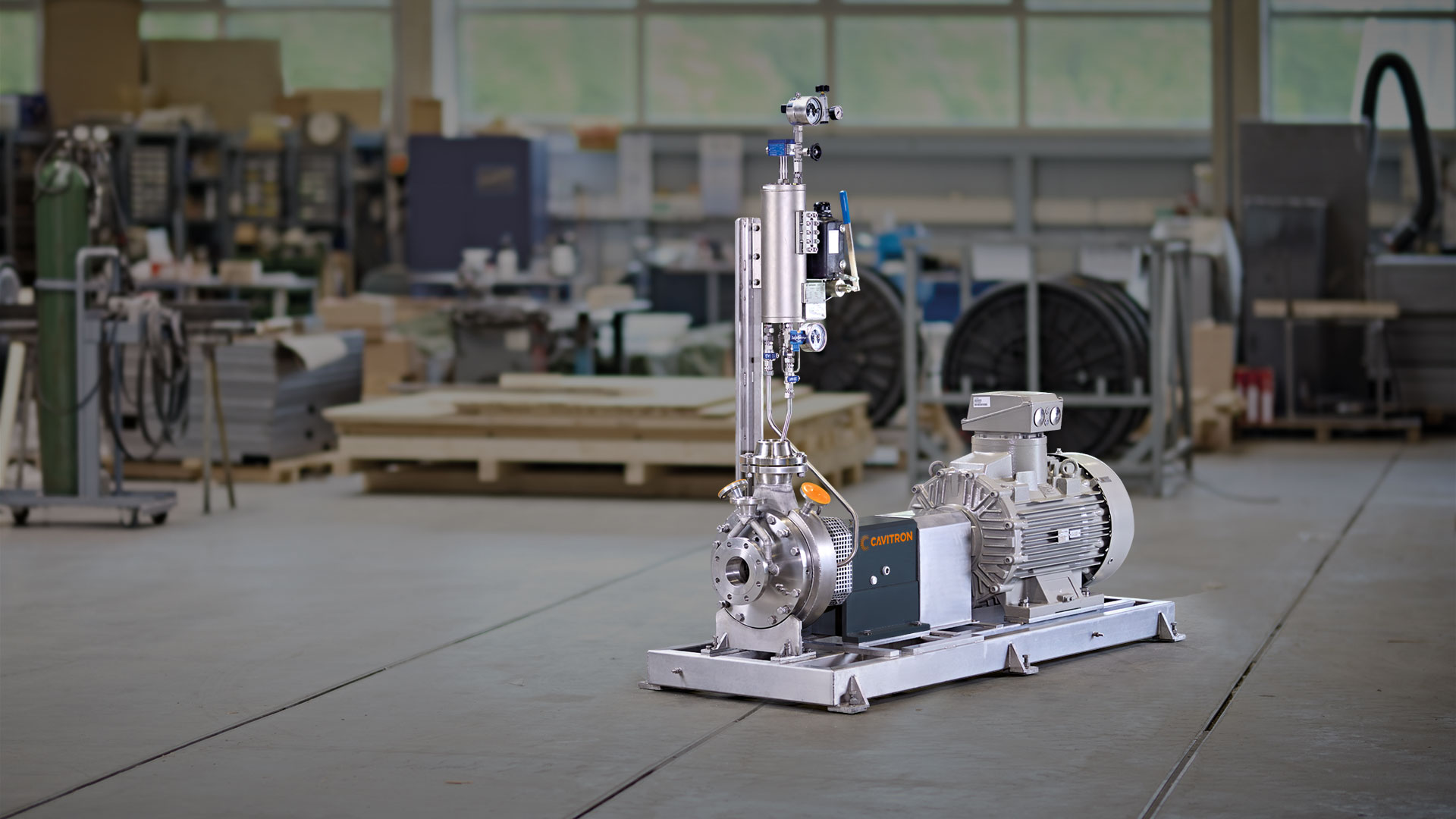
Cavitron rotor-stator systems support wetting and deagglomeration of silica in the resin. Performance depends on the interaction between silica grade, resin formulation and mechanical processing. AEROSIL® is an Evonik trademark; different silica grades are not directly interchangeable.

What the dispersion process must achieve
- Thorough wetting: The lightweight powder can only be distributed uniformly when the resin phase adequately wets its surfaces.
- Defined dispersion quality: Agglomerates must be broken down in a controlled manner. These must be distinguished from the strongly bonded aggregates of fumed silica.
- Appropriate rheology: Hydrophilic and hydrophobic grades interact differently with the resin phase. Concentration and processing jointly determine structure development.
- Temperature and air: Heating and air entrainment influence processing and quality. Reactive resins also require consideration of storage stability and subsequent curing.
Match dispersion to the resin and silica
The rotor-stator system distributes wetted silica throughout the resin stream and breaks down agglomerates through intensive shear and turbulent flow. Tool configuration, speed and throughput are selected to achieve the required dispersion quality at an appropriate product temperature.
The machine can be integrated into continuous resin preparation or a vessel recirculation loop. Powder dosing, feeding, cooling and, where necessary, deaeration must suit the formulation. Silica dispersion and the later addition of components that initiate curing must be treated as separate process engineering tasks.
Performance is assessed through rheology measured under defined conditions. More shear does not automatically produce a better product. Nor can the proportion of reactive diluents such as styrene be reduced arbitrarily simply by dispersing more intensively.
Benefits at a glance
1
Uniform silica wetting
2
Targeted deagglomeration
3
Reproducible rheology
4
Coordinated temperature management
5
Integration into resin preparation
Benefits for your production
Uniform incorporation: Defined wetting and distribution reduce local differences in silica concentration, establishing the basis for consistent resin quality.
Targeted agglomerate breakdown: Mechanical processing is set to achieve the required dispersion quality rather than simply the highest possible shear intensity.
Reproducible rheology: Defined dosing and operating parameters support comparable viscosity, thixotropy and structural recovery between production runs.
Appropriate temperature management: Energy input is considered together with heat removal to limit thermal stress on the resin system.
Integration into preparation: Inline dispersion can be combined with raw material dosing and downstream processing. Design also considers cleaning and product changeovers.
Design based on measurable rheology
Selection requires information on resin type, reactive diluent, silica grade and concentration, viscosity at process temperature and throughput. Permissible temperature, the intended integration and cleaning requirements are also relevant.
Suitable assessment criteria include viscosity at a specified temperature and shear rate, thixotropic behaviour, structural recovery, dispersion fineness and application and storage behaviour. Measurements and sample conditioning must be comparable.
Materials, seals and operating limits are selected for the particular resin system. Information on the range is available in the Cavitron datasheet.

engineered.