Background and Task
With steadily increasing traffic loads, the demands placed on modern asphalt pavements are also rising. Heavily trafficked areas such as highways, federal roads, airports and logistics facilities are permanently exposed to extreme mechanical and thermal stresses.
This leads to an increased occurrence of damage such as:
- rutting
- cracking
- material fatigue
- deformation of the asphalt surface
One of the most effective measures for improving asphalt performance is the modification of the bitumen binder with polymers. The targeted addition of elastomeric polymers, especially Styrene-Butadiene-Styrene (SBS), produces polymer-modified bitumen (PmB) or polymer-modified asphalt (PmA) with significantly enhanced properties.
Polymer modification substantially increases the elasticity and elastic recovery of the bitumen. This enables the binder to deform under dynamic loading and subsequently return to its original shape.
At the same time, low-temperature performance is improved, reducing the risk of thermally induced cracking.
Polymer-modified binders offer significantly higher resistance to:
- rutting
- fatigue cracking
- aging
- weathering effects
- cyclic loading
In addition to traditional road construction, PmB/PmA systems are also used successfully in the roofing membrane industry, where their high resistance to aging and weathering as well as enhanced elasticity offer decisive advantages.
The quality and long-term stability of polymer-modified bitumen depend largely on the quality of the milling, homogenization and dispersion processes.

The Challenges of Polymer-Modified Bitumen
Styrene-Butadiene-Styrene (SBS) is currently the most widely used polymer worldwide for the production of polymer-modified bitumen. SBS has excellent elastic properties and significantly improves the rheological properties of bitumen.
However, processing SBS places high demands on process engineering. In addition to milling the SBS granules, they must be wetted in hot bitumen, finely dispersed and homogeneously distributed.
At the same time, the polymer particles swell within the bitumen and form a stable polymer matrix. This maturation process is crucial for the final product quality.
Insufficient particle size reduction or incomplete dispersion frequently leads to:
- agglomerate formation
- uneven polymer distribution
- unstable morphology
- phase separation during storage or transport
- fluctuating product properties
SBS also tends to separate from bitumen at elevated temperatures. Consistently stable product quality therefore requires intense yet controlled shear stress.
Conventional processes using heated stirred tanks are often:
- energy-intensive
- time-consuming
- maintenance-intensive
- limited in terms of achievable dispersion quality
Especially at high polymer concentrations or large production volumes, traditional stirred-tank solutions and simply designed rotor/stator systems quickly reach their technical and economic limits.
The Solution: Cavitron Machines for Polymer-Modified Bitumen
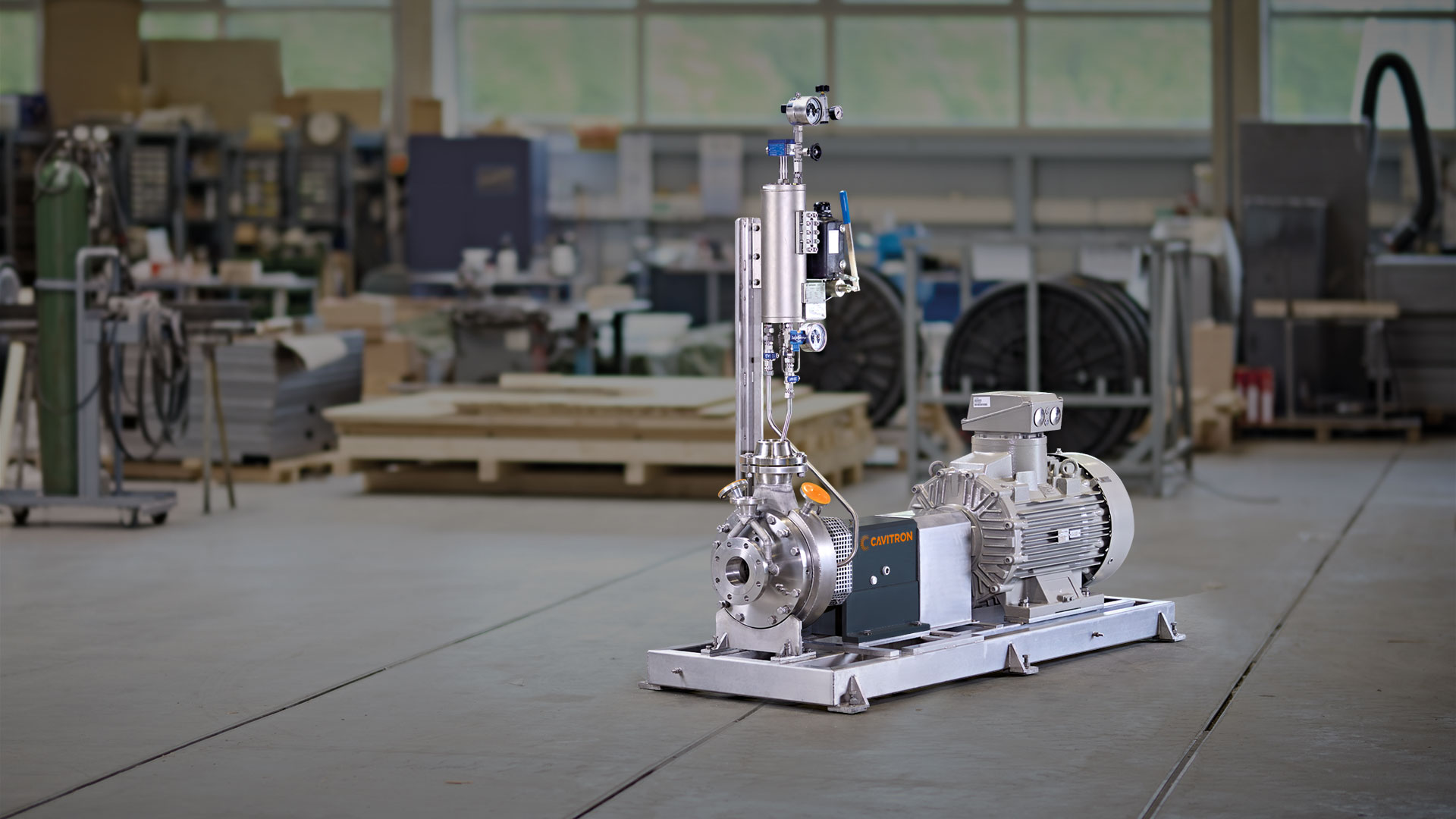
The centerpiece of modern plants for the production of polymer-modified bitumen and asphalt is the Cavitron machine, which is specifically tailored to the respective process.
By using high-performance rotor/stator systems, the machine generates high shear forces and intense turbulent flow within the product stream.
As a result, the SBS granules are:
- efficiently comminuted
- intensively wetted
- homogenized
- finely and permanently dispersed within the bitumen
Continuous forced conveyance through the rotor/stator working zone prevents agglomerate formation and ensures a uniform microstructure in the final product.
A key advantage of the Cavitron principle is the significant enlargement of the polymer surface area through intensive milling. This substantially accelerates the swelling and maturation process of SBS within the bitumen.
Cavitron machines can be used in:
- batch/circulation processes
- continuous production plants
Thanks to their modular design, the machines can be precisely adapted to:
- product viscosity
- polymer concentration
- temperature range
- throughput capacity
- specific customer process requirements
Various rotor/stator geometries also allow targeted adjustment of shear intensity and dispersion performance for different formulations and product qualities.
Customer Benefits
- high product quality through uniform and stable polymer distribution
- reliable prevention of agglomerates
- processing of large volumes and high polymer concentrations
- production throughputs of up to 50 t/h
- reproducible process and end-product quality
- improved storage and transport stability
- minimized phase separation and sedimentation
- improved viscosity stability, pumpability and compactability
- substantially reduced production and maturation times
- closed and low-emission process design
- high operational reliability with minimal maintenance
- flexible customization through tailored system concepts
Cavitron machines can be individually equipped with:
- various rotor/stator systems
- special shaft seals
- variable drive concepts
- heating or cooling jackets
- multi-component feed systems
- integrated dosing and process components
In addition to stand-alone machines, Cavitron offers hoppers, tanks, dispersers, dosing and conveying technology, as well as complete continuous PmB/PmA process plants for tailored overall solutions.
Conclusion
The production of high-quality polymer-modified bitumens and asphalts requires high-performance, process-reliable dispersion and homogenization technologies.
Particularly when processing SBS polymers, the quality of size reduction and dispersion plays a decisive role in determining the subsequent material properties and long-term stability of the final product.
Thanks to their specially developed rotor/stator systems, Cavitron machines enable highly efficient processing of SBS granules in bitumen.
The result is stable, homogeneous and high-quality PmB/PmA products with optimized performance characteristics for demanding applications in road construction and structural waterproofing.
Drawing on many years of experience in bitumen and process engineering, Cavitron is a valued partner, both nationally and internationally, for the planning of new production facilities and the optimization of existing processes.
Overview of Customer Benefits
1
High product quality
2
Processing of large quantities and high polymer concentrations
3
High process control for guaranteed reproducible quality
4
Stability and durability
5
Improved workability and mix quality
6
Low environmental impact and maximum occupational safety
7
Robust and versatile
8
Reduced maintenance requirements
9
Tailor-made solutions
10
Accessories and plant engineering:
Customer Benefits in Detail
- High product quality:
Rotor–stator systems developed specifically for bitumen applications ensure uniform distribution of the polymer (e.g., SBS) in the bitumen, prevent agglomeration, and deliver a consistent microstructure. - Processing of large quantities and high polymer concentrations:
With multiple machine sizes available, up to 50 t/h of PmB/PmA can be processed. - High process control for guaranteed reproducible quality:
The machine operates with precision and reliability, consistently delivering uniform product quality. Processes and results are reproducible at all times. - Stability and durability:
Optimal dispersion minimizes phase separation, ensuring higher stability during transport and storage. - Improved workability and mix quality:
Forced conveyance through the Cavitron machine prevents unmixed polymer from entering the final mix. Air entrainment and demixing are reduced, resulting in more stable viscosity and improved compaction performance. - Low environmental impact and maximum occupational safety:
Since processing occurs in a closed system, no particles or vapors are released. - Robust and versatile:
A robust design for operation under demanding conditions, suitable for processing various product grades and formulations. - Reduced maintenance requirements:
Intensive particle size reduction minimizes residue buildup in plant components and reduces the need for frequent cleaning. - Tailor-made solutions:
Cavitron machines can be individually configured to meet specific applications and customer requirements. Options include various rotor–stator systems, shaft seals, motors and drives, heating/cooling jackets, injection ports, and multistream inlets. - Accessories and plant engineering:
In addition to stand-alone machines, Cavitron provides complementary system components (hoppers, tanks, dispersers, etc.) as well as complete process plants.
With many years of experience in the bitumen-processing industry, we have become a highly respected partner—both nationally and internationally—for the design and manufacture of new machinery as well as the optimization of existing process technology.
General Technical Specifications
Static seals:
Viton, Teflon, Kalrez, other elastomers.
Operating pressure:
Application-dependent, up to 100 bar; standard: up to 10 bar.
Operating temperature:
Application-dependent up to 250 °C; standard: 150 °C.
Performance and energy consumption:
Type overview available for download.
Drives and power transmission:
Three-phase motors, high-frequency motors, mechanical gear units, variable-speed drives, stepless electronically controlled and monitored systems.
V-belt and Poly-V belt drives.
Intensity levels:
Application-specific, ranging from coarse mixing to dispersion in the angstrom range.
Bearings:
Tapered roller bearings, angular contact ball bearings (double).

engineered.